
Managed print services near you, and how thick the cover is
- 5.0 on Google from 150+ reviews
- Trading since 2010
We cover all 8 states and territories in Australia.
- Written for organisations running five or more offices.
- Twenty areas named below, each with an honest note.
- One attendance commitment, identical everywhere
Send the list of addresses
- 5.0 Google rating, from 150+ five star reviews
- Since 2010 Australian owned and Queensland based
- 500+ Australian businesses on an agreement with us
- Next day A technician on site the next business day
Trading year and client count: published by Global Document Solutions, who operate this service, and read from their site on 5 September 2026.
Rating and review count: from the Google Business Profile for Global Document Solutions, read the same day.
Next business day attendance: a commitment we make, not a measured result.
Why a page about coverage has to name the places it is thin
The workshop is at Bethania in Queensland, south of Brisbane.
Every address, in that state and the other seven, is attended by our sister service company.
Attendance at all of them is next business day, logged at any hour.
An MPS agreement covers the multifunction devices, the toner and the servicing at each address.
This page exists because searching for managed print services near me returns a particular kind of answer.
Companies who will claim your area and work out how to reach it afterwards.
The wording in the agreement is the part worth quoting, because it is the part you can hold us to.
“A technician will attend the site on the next business day following a fault logged at any hour.”
It is a term of the agreement rather than an average we have measured, and there is no credit attached to it.
The label beside each area is the state it sits in, nothing more.
There is no ranking in it, because the same service company attends every address in all eight.
The note underneath says how many of their technicians sit within reach of that area.
Nothing on this page says a place is easy when it is not.
That is the whole point of it.
Last updated 5 September 2026.
What do print management companies near you actually mean by coverage
Usually 1 of 2 things, and they are rarely told apart in a sales meeting.
Ours is the second, said out loud, and it applies at every address in the country without exception.
Managed print solutions near me returns this same set of suppliers.
So does managed print services providers near me.
What neither search will tell you is which of those suppliers can actually reach your third office next Tuesday.
One workshop, at Bethania
The agreement, the rate card and the ticket queue are run from there, for every address in the country.
An escalation stays inside the state it is raised in.
One service company, in all eight
A sister company of ours, under contract to us.
We hold the agreement, set the rates, run the queue and pay them.
You never deal with them commercially.
One agreement, one rate card, one number to call
One monthly report covering every address, and the same next business day attendance at all of them
Which capitals are covered, and by whom
All 8 of them, attended the same way, on the same next business day commitment.
The label on the right is the state. The note underneath counts the technicians within reach.
-
Brisbane and Ipswich
Queensland
The corridor the business grew up serving, with several technicians across the metro.
The workshop that runs the agreement and the ticket queue sits south of the city at Bethania.
-
Gold Coast
Queensland
Southport to Coolangatta and the hinterland behind it, straight down the motorway from the workshop.
-
Perth
Western Australia
Two hours behind the eastern states, and the desk that holds the agreement opens before a Perth office does.
Metro cover is solid, and distance is the constraint in this state, past the metro rather than inside it.
-
Adelaide
South Australia
The city where a fleet is most often held up by contracts that expire in five different months.
Good cover across the metro, and a compact one, so the outer sites are less of a routing problem here than in Melbourne or Perth.
How managed print in Adelaide works around staggered renewals
-
Sydney
New South Wales
Our thickest cover anywhere in the country, with several technicians across the metro.
-
Melbourne
Victoria
Strong through the inner and middle ring, thinner past it.
-
Canberra
ACT
Well served.
Government and legal work here means secure release is usually part of the conversation rather than an afterthought.
Which release rule each device in an ACT office gets is worked through district by district.
-
Hobart
Tasmania
Covered, with fewer of that company’s technicians within reach than any mainland capital.
We treat a Hobart site as a named single point rather than pretending otherwise.
What Bass Strait changes for a Tasmanian fleet, and what it does not has the longer answer.
-
Darwin
Northern Territory
Covered.
Thin, seasonal, and the one capital where we will talk to you about holding a spare device on site instead.
Can managed print services companies actually reach a regional branch
Every regional address in the country is attended by that same service company, on the same next business day commitment.
The centres named below are the ones we can describe from agreements we already hold.
What varies is how many technicians sit within reach, and an area with one nearby says so.
The same reasoning decides why a smaller Gold Coast fleet is not rated worse for sitting outside a capital.
-
Regional Queensland
Queensland
Cairns, Townsville, Mackay, Rockhampton, Bundaberg and Toowoomba, drawn to scale by road distance on their own page.
What seventeen hundred kilometres of regional Queensland does to a fleet
-
Newcastle
New South Wales
Deep enough here that one technician being busy does not become your problem.
Several technicians within reach, effectively metro grade cover.
-
Central Coast
New South Wales
Gosford through to Wyong.
Well covered, and close enough to both Sydney and Newcastle to have real depth behind it.
-
Maitland
New South Wales
Served off the Newcastle pool.
Straightforward, and one of the few regional addresses where we hold more than one option.
-
Hunter Valley
New South Wales
Cessnock, Singleton and Muswellbrook.
Fine, with longer drives than the map suggests once a site is off the highway.
Sold locally as managed printing solutions in the Hunter Valley, on the terms named here.
-
Port Macquarie
New South Wales
Covered by a single strong operator.
That works, and it means a bad week for them is visible to you in a way it would not be in Sydney.
-
Taree
New South Wales
One operator, shared with the Port Macquarie area.
We name this as a single point of dependency in the scope, every time.
-
Bendigo
Victoria
One good firm.
The commitment holds and there is little slack behind it, which is the honest description of most inland Victorian towns.
-
Sale
Victoria
Gippsland.
One technician within reach, long drives, and an address where we would rather over specify the device than argue about response later.
-
Hobart
Tasmania
Listed here as well as above because for most mainland fleets a Tasmanian site is a regional site in practice, whatever the map says.
-
Tom Price
Western Australia
Pilbara.
The hardest address on this list and the most honest test of a coverage claim.
We will quote it, and we will tell you exactly how it is resourced first.
- Send us every address, including the remote ones you assume are a problem
- We check each against the cover map and tell you where 1 technician is within reach rather than several
- Anything we cannot cover yet is named as such rather than promised
If your address is not on this list, it is not a refusal.
It means we have not placed a device there yet and we would rather check how deep the cover runs before promising you anything.
Ask, and the answer comes back with a name attached.
Send the print volumes as well and the rate comes back with it.
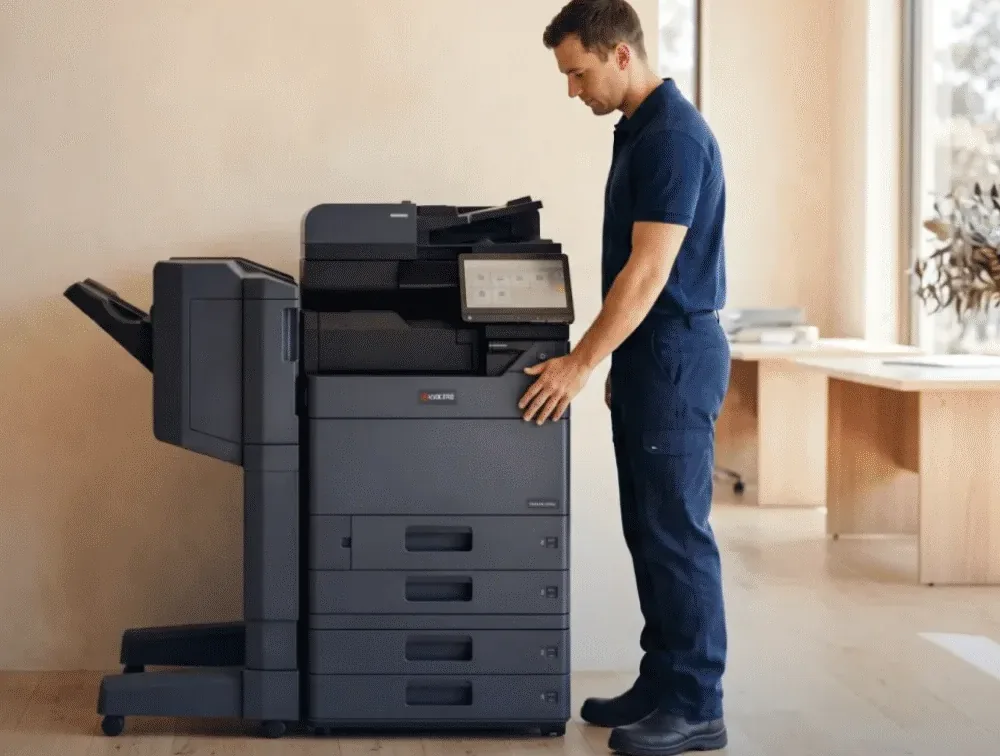
From $160 + GST a month per device.
Volume is pooled across every site, so a larger fleet prices into a lower band.
Paper, staples and pages above your agreed volume sit outside that figure.
How is managed print handled at a Newcastle office
A Newcastle office runs on the same agreement as a Sydney one, in the same words.
Our sister service company attends both, and it holds several technicians within reach of the Hunter.
That is what the area list above calls metro grade cover.
Maitland and the Hunter Valley are served off the same pool.
So is the Central Coast, which sits between the two cities.
The M1 between them runs 127 km, from Wahroonga to Beresfield.
That distance is carried by the service company rather than added to your invoice.
The attendance commitment reads the same at a Newcastle address as at a Sydney one.
The rate band does not move across the drive either, because volume pools across every address you run.
Newcastle is named here as an example, not as the edge of the map.
Every address in Australia is covered, and the depth behind each one is what we put in writing.
Why is there not a page for every town
Because sixteen near identical pages with a town name swapped in would tell you nothing you did not already know.
A buyer running 6 offices is comparing addresses, not reading about one of them.
The document that helps is a single list with every address on it and the weak ones marked.
That is what the table further down this page is.
It is also the only format that can be corrected in one place when the depth behind an area changes.
Most suppliers publish the town pages anyway, because a page per town ranks for a while.
It ranks by matching a place name rather than by answering the question the searcher had.
The question a multi site buyer actually has is whether their weakest address is covered properly.
No town page has ever answered that, because a town page cannot see the other 5 addresses.
We would have to invent the content
Sixteen near identical pages with a town name swapped in is what most suppliers do.
It tells you nothing you did not know.
Everything true about Taree is on this page, in 3 lines, next to the other 21 areas.
A page written to fill 800 words about a town we visit occasionally would be padding, and padding reads as padding.
The 3 honest lines are the depth, the attendance term and whether a single technician is the dependency.
Everything else on such a page would be the same sentence with a place name changed.
A reader can tell within 2 paragraphs when that has happened, and it costs the trust the page was written to build.
So the town sits in the table instead, with the same 3 facts as every other entry.
You are comparing, not browsing
Nobody with 6 offices wants 6 tabs open.
The useful view is all 6 addresses on 1 screen with the weak ones marked.
That is a table, not a set of landing pages.
Six tabs open is 6 chances to miss the one address that is thin.
One screen with all 6 on it makes the weak entry obvious in a glance.
That is the document a buyer takes into a procurement meeting.
It survives being forwarded, because nothing on it depends on where you landed first.
Print it, mark the 2 thin addresses and the conversation with a supplier starts in the right place.
That is the whole purpose of publishing depth rather than a shaded map.
A map says yes to every address and is therefore worth nothing to a buyer comparing 2 suppliers.
Thin pages age badly
How deep the cover runs changes.
One page can be corrected in a minute and dated at the top.
Sixteen pages go stale one at a time and nobody notices which.
Depth of cover is the fact most likely to move, because it follows where technicians live and work.
A single dated page can carry that change the day it happens.
A set of town pages carries it whenever somebody remembers to open each one.
A coverage claim that is 18 months out of date is worse than no claim, because a buyer plans against it.
One page carries a single date at the top and that date is either current or obviously not.
Sixteen pages carry 16 dates, and nobody checks them.
The date at the top of this page is the date the depth figures on it were last read.
What does the coverage look like in one table
According to how the agreement is actually written, this is the whole picture in 5 rows.
| Where | Who attends | Attendance | Technicians within reach |
|---|---|---|---|
| QLD metro | Our service company | Next business day | Several per area |
| NSW and ACT metro | Our service company | Next business day | Several per area |
| VIC, SA and WA metro | Our service company | Next business day | Several in the inner and middle rings |
| Regional, well served | Our service company | Next business day | More than one, named in the scope |
| Regional, single technician | Our service company | Next business day | One, named as a dependency |
The two middle columns are identical in all 5 rows and always will be. Only the last one moves.
Per the wording of the agreement it does not vary by state, by distance or by site size.
The commitment in full, including what is not promised, is on the managed print page.
To price the addresses rather than just confirm cover, send the page counts and take a written figure per site.
What buyers ask about cover across Australia
Do you cover my area?
We cover all eight Australian states and territories.
The business is based in Queensland.
Every address, that state included, is attended by our sister service company, which we dispatch and manage.
Sixteen regional centres and every capital are named individually on this page.
Each carries an honest note on how many of their technicians sit within reach of it.
Every address in Australia is covered, on the same terms, in all 8 states and territories.
The places named on this page are the corridors we can describe honestly rather than a boundary around the service.
What genuinely varies is depth, meaning how many of our sister service company’s technicians sit within reach of a given address.
In a capital that number is usually 3 or more, and in a single site regional town it can be 1.
Send the address list and each entry comes back marked with the depth behind it before you sign.
What does managed print coverage actually mean?
It usually means one of two things and they are rarely told apart in a sales meeting.
Either the supplier employs the technician who attends, or the supplier contracts that work out.
In both cases the agreement, the rates, the ticket queue and the reporting stay with the supplier.
A supplier who will not tell you which applies at your address is telling you it is the second.
Most supplier coverage maps shade a state and stop there, which tells a buyer nothing about the address they actually occupy.
The useful question is who attends, how quickly it is committed to in writing, and how much slack sits behind that commitment.
On this site the attendance term is the same next business day at every address, and it is written into the agreement.
The depth behind it is published per area rather than averaged into a single national number.
That is the difference between a map and an answer.
Can managed print reach a regional branch?
Yes, and the attendance commitment does not change with distance.
What changes is how many technicians sit within reach of that commitment.
Newcastle and the Central Coast are effectively metro grade.
Taree, Bendigo, Sale and Port Macquarie rest on a single operator each.
We name each of those as a single point of dependency in the scope.
A regional address carries the same written commitment as a capital city floor and sits in the same rate band.
Distance is carried by the service company rather than added to your rate as a travel surcharge.
Toner reaches a regional site on the same replenishment alert as a city one.
Where a town rests on a single technician, that address is named as a single point of dependency in your scope.
You hear that at the quote rather than after the first breakdown, which is the only time it is any use.
According to the depth figures published on this page, that pattern holds in every state.
Send us the list of addresses
Paste the whole list, including the ones you assume are too remote.
You get back a note against each address saying who attends it.
It also says whether we hold one option there or several.
Downtime at a thin address is the risk that note exists to name.
What their customers write on Google
Managed Printer Services is new. Global Document Solutions, who run it, is not.
When something breaks
We have had a great experience with this team.
They are always prompt, helpful and really easy to deal with.
Any issues are sorted quickly and the whole printer leasing process has been seamless.
On price, and on being told things
I highly recommend Cyrus at Global Document Solutions.
The service was brilliant from start to finish, with clear communication and attention to detail.
Pricing was extremely competitive and offered value for money.
Replacing a machine already on contract
We replaced our existing machine (also through GDS) and, as always, the process was seamless.
We had our machine up and running with minimal downtime.
These are reviews of Global Document Solutions, who operate this service, and not of this site.
Each one is copied word for word from their Google Business Profile, under the name Google shows, read on 7 September 2026.